
B15 · Houseware & Kitchenware
Stainless Steel in Houseware & Kitchenware: 304/201 Selection and a List of 4 Applications
In houseware and kitchenware, we have compiled 4 applications using stainless steel: most commonly 304 / 201 / 316, thickness from 0.3–5 mm.
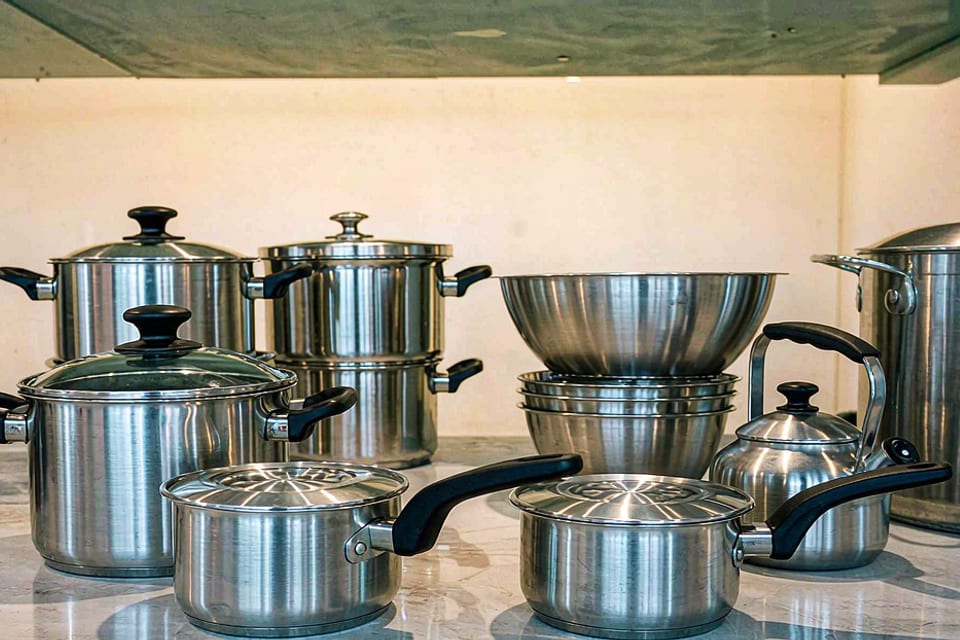
Selection List for 4 Applications
| Part / Detail | Suggested Grade | Size / Thickness | Surface | Common Failure | Reference Conditions |
|---|---|---|---|---|---|
| Pan trays / water cups / thermal carafes | 304/316/201 | 0.3–1.2mm | 2B / electrolytic bright / brushed | Food discoloration + acid + utensils + thorough cleaning | GB/T 3280; GB 4806.9 |
| Collapsible / blade | 420/440 | 1–5mm | Metal finish | Ensure the cutting edge does not chip | GB/T 1220; GB 4806.9 |
| Sink / kitchen counter / backsplash | 304/201 | 0.8–3.0mm | 2B / brushed / embossed | Harmful substances + detergent + scratches + food contact | GB/T 3280; GB 4806.9 |
| Bathroom accessories / towel racks | 304/201 | 0.5–2.0mm | Matte / rough / rough electrolytic | Humidity + oil + residue + hand sweat | GB/T 3280 |
In the tableTypical ConfigurationSteel Grade Selection
Industry Notes
- The most common grades are 304 (1), 201 (1), 316 (1) — select products (1) as a starting point for quotation and stocking.
- In acidic environments, 316L is the starting point. When the environment is acidic, start with 316L. As pH and temperature increase, consider 904L / duplex (2/4 items). As pH rises with temperature, consider 904L / duplex (2/4 — see new products).
- From 0.3–5 mm: thin steel is typically used for formed parts (at minimum account for deformation during bending and pressing); thick steel is typically used for welded structures (at minimum account for heat input and oxidation).
Frequently Asked Questions
Which stainless steel is most used in houseware and kitchens?
Based on the statistics for these 4 applications, the most common grades are 304 (3), 201 (3), 316 (1). Depending on the specific environment and temperature, for example, a stainless steel countertop exposed to salt water may need to move from 304 to 316L.
Where are the most vulnerable points?
Typical failure description for "inner wall of cookware / cups / thermal carafes": food contact + salt/acid + cleaning + dry-burn discoloration; recommended grades 304/316/201, thickness 0.3–1.2mm. For this type of condition, it is recommended to specify medium concentration, temperature and cleaning method during the design phase.
How to choose thickness?
Thickness values in the list range from 0.3–5 mm. For thin steel, consider formability and surface; for thick steel, consider stiffness and structural strength; values for the same application vary between equipment manufacturers, so check against your drawings or operating conditions.
Related Material Types and Industries
Delivery Examples under Similar Conditions
Houseware & Kitchenware
Stainless Steel Coils · 0.4–3.0 mm
304 / 201 stainless steel coils, deep-drawn and welded, 2B and BA surfaces, thickness 0.4–3.0 mm, by diameter and weight per coil.
Applications4
Thickness0.3–5mm