
Shipbuilding & Offshore
Seawater is the harshest natural electrolyte: roughly 19,000 ppm chloride combined with wet-dry cycles and crevices. Here the first criterion is not strength — it is whether the material resists crevice corrosion.
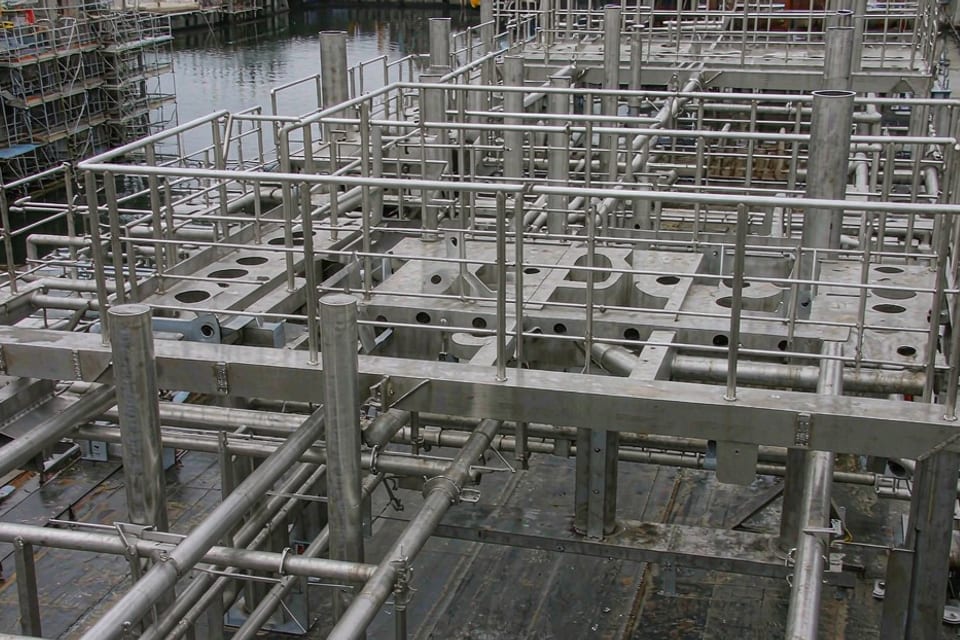
Typical Components and Material Selection
| Component | Steel Grade | Finish / Dimensions | Notes |
|---|---|---|---|
| Deck railings / fittings | 316L | Tube / profiles, polished | Salt spray, post-weld passivation |
| Seawater piping | 2205 / 6Mo | Seamless / welded pipe | Pitting, flow erosion |
| LNG tank inner shell | 304L / 304 | Plate 8–50 mm | Low-temperature toughness, class approval |
| Accommodation / galley equipment | 304 / 316L | 0.8–2 mm, 2B/HL | Cleanability, fingerprint resistance |
| Clamps / fasteners | 316 / 2205 | Bar / forgings | Stress corrosion cracking |
Three Practical Constraints in This Industry
Crevice corrosion is the primary failure mode
Under gaskets and at contact points between brackets and hull, 304 rusts within months. By design, eliminate crevices (continuous welds, drain holes) and upgrade to 316L or 2205.
Confirm class approval as early as possible
DNV / ABS / LR / CCS each maintain their own approved material lists. A better grade that is not approved still fails inspection — please check at the quotation stage.
Welding distortion accumulates through to assembly
Thin-wall outfitting components distort and accumulate tolerance errors during final assembly. Pre-fabricate by sub-block with anti-distortion jigs, and leave machining allowance.
Related Products
Need a quotation or technical support?
Send us the component, steel grade, dimensions, quantity and destination port — we respond with FOB / CIF within 24 hours.